When peptide vendor reviews conflict, check the evidence behind each claim: can a lab report be tied to the specific lot, what did the laboratory actually test, and are the seller's contact details and dispute policies clear? Treat missing information as an unresolved gap, not proof of fraud. A high rating, a COA, or a “lab tested” badge alone does not establish product safety.
Open Next Pep's library to review available vendor details. Next Pep brings vendor names, listed prices, shipping locations and report links together where those fields are available, giving you a starting point for checking the underlying evidence.

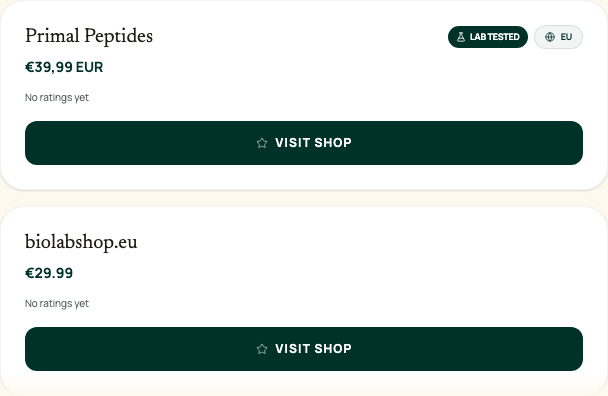
Actual vendor-card interface captured September 17, 2026. These listings illustrate the workflow; they are not recommendations. Prices and availability can change. The “Lab Tested” badge appears when a report URL is supplied, not after an automatic verification of the current lot.
What the complaints actually tell us
The frustration is understandable: a polished website promises transparency, but the information needed to check that promise is missing or difficult to obtain. Public reviews can identify the questions to ask. They cannot, by themselves, answer whether a particular vial meets a specification.
Here are examples from public Trustpilot pages we read on September 17, 2026:
| Reported problem | What the source says | What to check next |
|---|
| A COA cannot be matched to the shipment | A one-star Bulkpeptidesupply review dated May 23, 2026 reported absent batch IDs on vials. | Request the lot identifier and a document that connects that lot to the report. |
| Requested testing information cannot be found | A one-star Purity Peptides review, with an experience date of July 1 and an update on July 9, reported missing COA information. | Request the exact report URL, issuer and verification reference for the product concerned. |
| Communication does not resolve uncertainty | Another one-star Purity Peptides review, published July 13 for a July 10 experience, complained about transparency and communication. | Ask a specific written question and record whether the answer supplies the requested evidence. |
| A shipment issue remains unresolved | A one-star Bulkpeptidesupply review, published May 21 for a May 6 experience, described a missing part of a split shipment. | Check the promised shipment schedule, carrier acceptance and written resolution policy. |
Sources: Bulkpeptidesupply reviews and Purity Peptides reviews.
The responses matter too. In its July 9 reply to the COA complaint, Purity Peptides said it could not locate the described correspondence, stated that applicable product pages carry COAs with verification codes, and offered to investigate. We have not adjudicated that dispute or independently tested either vendor's products. These US and Canadian examples are a targeted sample, not a prevalence estimate or a ranking of suppliers.
Separate three different questions about trust
A useful vendor check keeps these questions apart:
- —Is the seller accountable? Can you identify the business, reach an appropriate contact and find written policies?
- —Is the analytical evidence traceable? Can you connect the offered product and lot to an authentic report with a clear test scope?
- —Is the product appropriate for its intended use? That requires more than commercial transparency. A research report does not establish medical approval or suitability for a person.
Fast delivery is evidence about fulfillment, not chemical identity. A laboratory result is evidence about a submitted sample, not a promise that customer support will resolve a later problem. Keep both in your notes instead of collapsing everything into one star rating.
Turn each complaint into a document request
“There is a COA, but which batch is it for?”
Record the product name, stated quantity, lot or batch identifier, report date and report reference. Ask how the lot on the product or shipment maps to the lab's sample description. Matching only a compound name is not enough to connect a report to a particular shipment.
The report date is useful context, but a universal “older than six months means fake” rule is not a reliable test. The unresolved issue may be lot identity, storage history, or whether the available stock is the material described. Ask which question the documentation actually answers.
Finnrick's published methodology treats labeling, identity, purity and quantity accuracy as distinct inputs, and distinguishes product-adjacent batch identification from website-only claims. That is a useful example of a disclosed method, not a standard we have independently certified or a recommendation of every vendor it lists.
“The PDF says 99%, so what else do I need?”
Read the measurement name and method before the percentage. An HPLC purity result and net peptide content are not interchangeable. GenScript's peptide documentation explicitly distinguishes peptide purity from peptide content.
Check what is actually reported:
- —Identity: what analytical evidence supports the sample identity?
- —Purity: which method and result are stated, and what can that method detect?
- —Quantity or content: was an amount measured, or does the document only repeat the submitted sample's label?
- —Additional testing: are sterility, endotoxins or other relevant analyses explicitly included, or absent from the report?
A result under one heading should not be silently treated as a pass under the others. Finnrick, for example, publishes separate testing options; its methodology also explains that most panels do not include an endotoxin result. “Not reported” means you do not have that result.
“The verification link looks official”
Navigate to the issuing laboratory independently rather than relying only on a logo or a vendor-hosted screenshot. Use the lab's verification method or ask the lab how it confirms an issued report. Compare the resulting record with the document you were shown.
Even an authentic report leaves a separate question: who selected and submitted the sample, and how is it connected to the current stock? Record what is known about sampling and custody. An unavailable verification page may be a temporary access problem; it is a reason to seek clarification, not sufficient evidence to accuse someone of forgery.
“Support keeps replying, but never answers the question”
A quick reply and a useful reply are different. Send one concrete request for the missing evidence. Keep the date, response and any promised follow-up together. A discount code, a generic purity claim or a second copy of the same unmatched PDF does not fill a missing lot reference.
For fulfillment complaints, separate a label-created event from a carrier record showing receipt. For a return or refund dispute, compare the seller's actual policy with the promised remedy and any later update from the reviewer. A complaint that was subsequently resolved should not remain described as unresolved.
A research supplier declining to give personal dosing advice is not, by itself, a transparency failure. Ask for product documentation and order information; medical advice belongs with an appropriately qualified clinician or pharmacist.
A simple evidence worksheet
Copy this table into your notes for each vendor you are checking. Use documented, missing or disputed rather than awarding a trust percentage that the evidence cannot support.
| Item | Record | Status |
|---|
| Business identity | Legal/trading name, contact page and date checked | Documented / missing / disputed |
| Product and lot | Exact product, stated quantity and lot identifier | Documented / missing / disputed |
| Report | Issuer, report reference, test date and original link | Documented / missing / disputed |
| Test scope | Which results are measured, and which are absent | Documented / missing / disputed |
| Lot connection | How the report relates to offered or received stock | Documented / missing / disputed |
| Dispute handling | Shipping/return policy, specific question and response | Documented / missing / disputed |
| Recommendation context | Sponsorship, commission or other disclosed relationship | Documented / missing / disputed |
A missing field is an open question. A disputed field records conflicting accounts. “Documented” means you located the specified evidence; it is not a blanket safety endorsement. If a required condition remains unresolved, pause the decision rather than replacing it with a favorable review score.
Questions you can send to a supplier
Please provide the report for the specific product and lot currently offered. What identifier links that lot to the laboratory sample? Which tests were performed, and which were not? How can I confirm the report directly with the issuer? What is your written process if the delivered label, quantity or lot differs from the order?
That request asks for verifiable details without presuming misconduct. Keep any reply with the original question. Do not publish personal information or present a lack of response as a completed fraud investigation.
Check incentives behind recommendations
Look for whether a review or comparison discloses a commercial relationship. A discount code is not proof of a paid arrangement, but it is a reason to check the disclosure. Likewise, an enthusiastic testimonial cannot substitute for the underlying report.
The FTC's endorsement guidance explains why material connections can affect how consumers weigh recommendations and why disclosures should be clear. For this guide, source links document evidence and methodology; they are not a recommended shopping list. This page is published by Next Pep and promotes our own research platform.
What Next Pep can help you check
Start in the research library, open a relevant compound, and choose Vendors. At the time of our check, the public BPC-157 profile showed vendor names, prices where provided, a shipping-region label, and a linked lab report on one card. Both cards showed “No ratings yet.”
Use that interface to locate available information, then check the original documents. Next Pep does not establish current-batch authenticity merely by displaying a vendor or report link. Missing ratings are not bad ratings, a shipping region is not proof of manufacturing origin, and a listed price is not necessarily the delivered total.
The screenshot shows this interface, not a test of those vendors. We did not place an order or send samples to a laboratory for this article. To organize compound-level evidence separately from supplier information, use the comparison tool.
Frequently Asked Questions
Does a COA prove a peptide vendor is trustworthy?
It can contribute evidence about the tested sample and the measurements stated. It does not by itself establish the seller's handling of other lots, fulfillment, dispute resolution, or the safety of a product for human use.
Should I trust a one-star review?
Treat it as an account to examine. Look for dates, a specific issue, supporting documentation, the company's response and subsequent corrections. Neither a single complaint nor a collection of positive reviews replaces the missing evidence.
Is a “research use only” label a safety guarantee?
No. It does not establish medical approval or make a product appropriate for self-treatment. In an August 24, 2026 warning letter, the FDA addressed products marketed with research-only labels that the agency found were nevertheless intended for human use. This guide evaluates documentary transparency, not treatment choices.
Why not publish a list of the safest vendors?
We have not performed the product sampling, testing and ongoing assessment needed to support that promise. A transparent checklist makes the unanswered questions visible instead of turning limited evidence into a safety ranking.
Review available vendor information in Next Pep. Keep the original sources, dates and unresolved questions alongside every comparison.